
Ice Dams: How Massachusetts Homeowners Can Prevent Costly Winter Damage
Here is something we see every single winter in the towns we work in: a homeowner pays to have ice dams removed, feels relieved for a week, and then calls again when they come right back. It is one of the most frustrating patterns in home ownership, and we understand why it happens.
Ice dam removal companies are not in the business of putting themselves out of business. They show up, steam the ice off, and leave. The problem returns because no one ever looked at why it formed in the first place. That answer is almost never the weather. It is almost always what is happening inside your home.
At Platt Builders, we’ve worked in communities like Concord, Wellesley, Lexington, and Belmont for over 30 years. We have built a practice around understanding why things go wrong in houses, not just fixing the visible damage. Ice dams are a symptom.
This guide explains the cause, what a lasting fix actually looks like, and what to do if you are dealing with them right now.
What Are Ice Dams and Why Are They Dangerous?
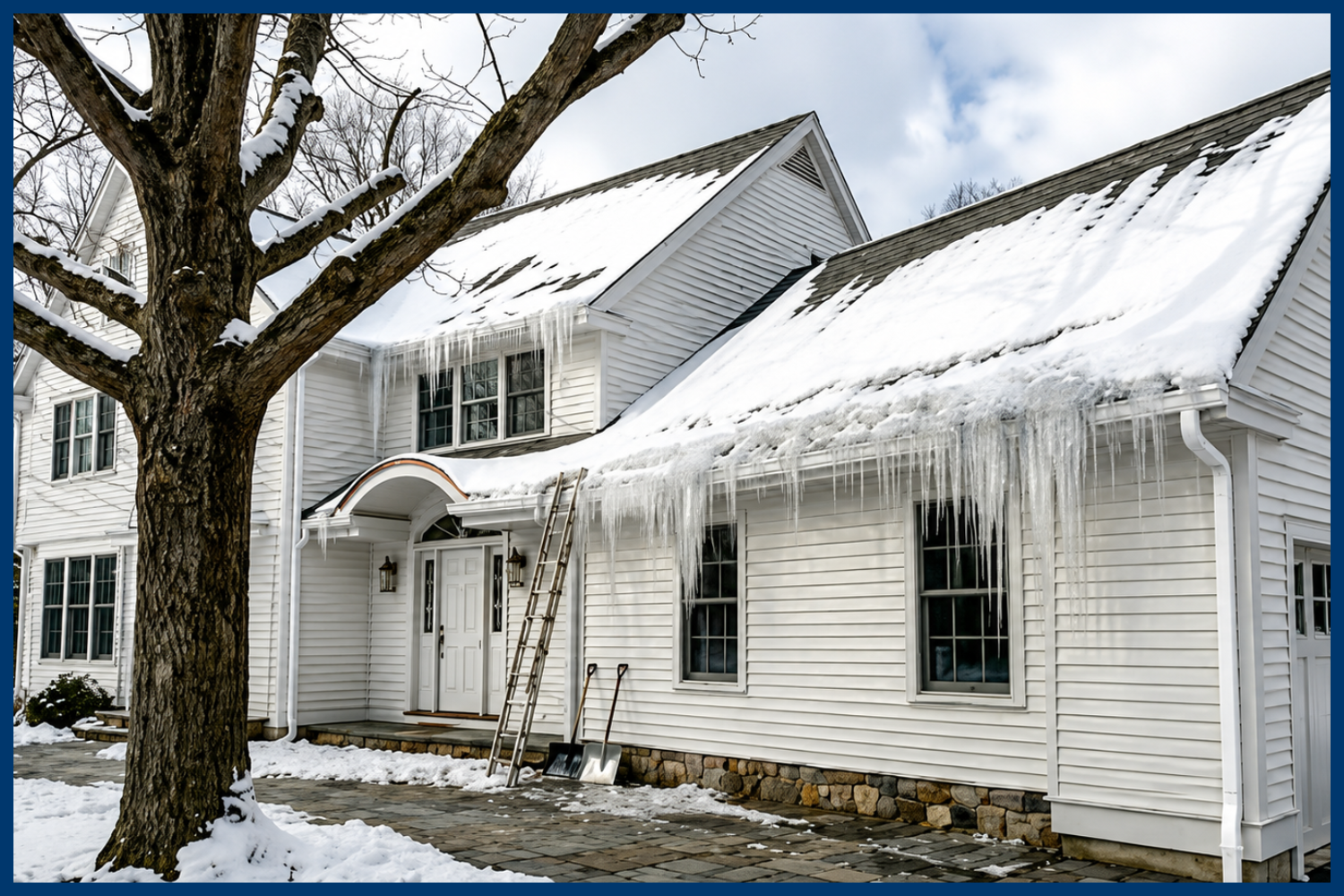
An ice dam is a ridge of ice that builds up along the edge of your roof and blocks melting snow from draining. The mechanics are straightforward: heat escaping from your living space warms the upper section of the roof deck and melts the snow above it.
That water runs down toward the eaves, which stay cold because they overhang the heated part of the house. When the water hits that cold zone, it refreezes. Each cycle adds another layer, and the dam grows, according to building science research.
Once that ice dam forms, subsequent snowmelt has nowhere to go. It backs up under your shingles, seeps through roofing materials, and finds its way into your home. The result can be:
Water-stained ceilings and walls
Damaged insulation that loses its effectiveness
Mold and mildew growth inside wall cavities
Rotting roof decking and structural framing
Peeling interior paint and plaster
Damaged gutters bent or torn away by ice weight
What makes ice dam damage so costly is how much of it is hidden. Water traveling behind a wall or through insulation does not announce itself right away. By the time a stain appears on a ceiling, the damage behind it is usually far worse than it looks.
For homeowners in Wellesley or Weston with high-value properties, a single bad season can result in tens of thousands of dollars in repairs, much of it discovered long after the ice is gone.
How to Prevent Ice Dams: Long-Term Solutions That Work
We want to be direct about something before getting into solutions: a roof rake and a bag of calcium chloride will not fix your ice dam problem. They will make it manageable through winter, but it’s not a long-term solution. De-icing cables are a slightly more expensive version of the same compromise.
We are not dismissing these tools entirely, and we cover them later in the section on immediate relief. But if you want to stop having this conversation every February, you need to address the heat loss that is driving the problem. Here is how we think about that.
1. Improve Attic Insulation
Most homeowners assume the roof is the problem. It is not. The attic floor is where the thermal boundary of your home should be, and in most of the older Massachusetts homes we work in, it is performing well below what it should.
Warm air from the living space rises, finds its way into the attic, and heats the underside of the roof deck. Massachusetts building codes now require significantly higher insulation values than older homes typically have, per the Massachusetts building energy code.
During a renovation, bringing your attic insulation up to current standards is one of the highest-return improvements you can make, both for winter comfort and for eliminating ice dams.
For homes in Lexington and Weston with finished attic spaces, cathedral ceilings, or complex rooflines where a traditional attic floor approach is not possible, we often recommend spray foam applied directly to the underside of the roof deck.
This creates what building scientists call a "hot roof" assembly: the attic becomes part of the conditioned space of the home, the temperature differential across the roof deck disappears, and ice dams stop forming. It is a more involved solution, but for the right home it is the most reliable one we have.
2. Ensure Proper Attic Ventilation
The goal of attic ventilation is not warmth. It is the opposite: you want cold outside air moving through the rafter bays so the roof deck stays uniformly cold and snow melts evenly, if at all.
Ridge vents working in combination with soffit vents create the continuous airflow that makes this possible. What we find in many older Massachusetts homes is that the soffits are blocked, packed with insulation from a previous improvement job, or were never properly detailed to begin with.
The ridge venting is often undersized or missing entirely. These are things we address as a matter of course during whole-home remodels, but they are worth having any contractor look at even outside of a larger project.
3. Seal Air Leaks Into the Attic: The Most Critical Step
Here is the thing that surprises most homeowners when we explain it: air leakage does more damage than poor insulation, and it is the leading cause of ice dams, as building science research confirms.
A recessed light fixture, an attic hatch without weatherstripping, the gap around a plumbing stack where it passes through the ceiling, the space around a chimney chase: each of these is a pathway for warm conditioned air to bypass your insulation entirely and pour directly into the attic.
You can have a foot of blown-in insulation and still have a serious ice dam problem if the ceiling plane beneath it is leaking air. During renovation work, our crews go through the attic systematically and seal these pathways before we close anything up.
In our honest assessment, this single step does more to eliminate ice dams than any other improvement. It also meaningfully reduces heating costs, which matters when you are heating a large older home in Needham or Wellesley through a Massachusetts winter.
Addressing Ice Dams During a Whole-Home Remodel
We want to be honest about timing here. Addressing ice dams as a standalone project is possible, but it requires opening up finished spaces, which means cost and disruption.
If you are already planning a whole-home remodel, the walls and ceilings are open anyway. That is the moment to do this properly and completely, not as a patch but as a permanent fix. During construction, our team can:
Install ice and water shield membrane along all eaves and in roof valleys
Upgrade insulation to meet or exceed current Massachusetts energy code
Seal every air penetration into the attic assembly
Redesign ventilation pathways for optimal cold-roof performance
Replace or reconfigure problem sections of roofline that trap snow
Massachusetts state building codes updated in 2023 include enhanced energy efficiency requirements that directly address these issues, and they reflect what building science has known for years. See the Massachusetts building energy code for details.
When we pull permits for your renovation, your project will meet these current standards. We do not see code compliance as a ceiling. We treat it as a floor.
What to Do If You Have Ice Dams Right Now (Temporary Relief)
If ice dams are forming right now, the priority is limiting damage while you make a longer-term plan. We want to be clear about what these steps are: emergency management, not a cure.
Think of it the way you would a roof tarp after a storm. It stops the bleeding. It does not fix the roof. You will very likely be dealing with this again next winter unless the underlying heat loss is addressed. (The Boston Globe recently covered what Massachusetts homeowners should know about ice dams, including guidance from a removal specialist and a Northeastern University building scientist, and we think it is worth a read.)
Remove snow safely. A plastic roof rake with an extension handle is your best tool here. Clear snow from the bottom 3 to 4 feet of your roof edge after each significant storm, which removes the source material before it can melt and refreeze.
Do not climb onto a snow-covered roof under any circumstances. It is genuinely dangerous, and you will not accomplish anything that cannot be done from the ground with the right tool.
Use calcium chloride, not rock salt. If an ice dam has already formed and is backing water up toward your shingles, calcium chloride ice melt in a nylon stocking laid perpendicular across the dam can melt a drainage channel through it.
This is a real technique and it works reasonably well on accessible sections of roof. Do not use rock salt. It damages shingles, corrodes gutters, and kills whatever is planted below your drip line. The cost savings over calcium chloride are not worth it.
Call a professional for removal. Steaming is the right method. It melts the ice using low-pressure vapor without the impact damage that comes from chipping, which can crack shingles and void manufacturer warranties.
Several contractors in the greater Boston area offer this service. Ask specifically whether they use a true steam machine or a hot-water pressure washer. They are not the same thing, and the pressure washer can cause roof damage.
Document the damage. If water has already entered your home, photograph everything before you touch it. Ceilings, walls, insulation, anywhere you see moisture or staining. Your insurance adjuster will need this documentation, and so will any contractor who is scoping the repair. Cleanup can wait until you have a complete visual record.
The Investment Case for Solving Ice Dams Permanently
The homeowners we work with in communities like Wayland and Bedford are not naive about money. They know the difference between a sunk cost and an investment. When we make the case for addressing ice dams permanently during a renovation, we are not asking them to spend more money on their project. We are showing them where their money goes further. Proper insulation, air sealing, and ventilation pay off in multiple directions at once:
Lower heating and cooling costs year-round
Elimination of recurring emergency service calls and repairs
Protection of interior finishes, millwork, and flooring
Improved indoor air quality by preventing moisture intrusion and mold
Enhanced home value and energy efficiency ratings
When ice dam mitigation is part of a whole-home renovation, the incremental cost is modest. The walls are already open. The work flows naturally alongside everything else.
Doing it as a standalone project later, with finished rooms that have to be opened up and repaired around the work, is significantly more expensive. And both of those costs are small compared to what a serious ice dam season can do to a high-quality interior.

Ready to Solve Your Ice Dam Problem for Good?
If you have been dealing with ice dams year after year and are ready to actually solve the problem, we would like to talk with you. And if you are planning a renovation, this is the right time to address it, before the walls close back up.
We work with families throughout Concord, Wellesley, Lexington, Belmont, Needham, and the wider greater Boston area on luxury whole-home remodels where this kind of building science work is part of how we approach every project.
Our team has worked on hundreds of Massachusetts homes across virtually every style and era. We have been inside the walls of enough Concord capes and Lincoln contemporaries and Belmont colonials to know where these homes typically fail thermally and why.
That knowledge matters when you are trying to address ice dams without gutting a finished space, or when you are planning a renovation and want to make sure the work you are doing actually solves the problem. See our portfolio of completed Massachusetts projects.
Reach out to schedule your initial consultation. With over 30 years of experience transforming Massachusetts homes, we have seen this problem in almost every form it takes. We know how to fix it for good.